
TL;DR
- Copy with at least 0.08 ETH of net worth in your agent wallet, because a smaller book cannot earn back the round trip
- Set Copy Percentage to your net worth ÷ the leader’s net worth, not to a number that sounds right
- Skip leaders whose average position age is under 1 hour, since you pay for every flip
- Keep spare ETH in the agent wallet for gas, on top of the capital you intend to deploy
- Never use a Max Increase Amount of 0: it copies nothing. Leave the field empty for no cap
- Read Robinhood PnL as indicative rather than settled. See Known limitations
Why Sizing Matters More on Robinhood
Copying one of the leader’s positions is not a single transaction. LP Agent swaps your ETH into the pool’s two tokens, adds liquidity, removes it when the leader exits, then swaps back to ETH. That is four gas-paying transactions per cycle, plus slippage on both swap legs: the swaps use your slippage setting (7% unless you changed it) so the route can fill, and the liquidity legs allow 1%. The important property is that most of this cost is fixed per cycle, not proportional to your position. A 0.01 ETH copy and a 0.5 ETH copy pay roughly the same gas and lose the same fraction to spread. Fee income, on the other hand, scales with position size. Below a certain size the two never cross, and a position can be a perfectly good trade for the leader while losing you money.LP Agent charges nothing to open a copy and 8% of the LP fees collected when a copy closes or claims fees. That is not what makes small copies unprofitable. Network gas and swap spread are. See the Fee Structure.
1. Copy With at Least 0.08 ETH of Net Worth
Before any field in the copy dialog matters, the wallet doing the copying needs enough behind it. Keep at least 0.08 ETH of net worth, counting holdings and open positions, in the agent wallet your copies run from. That figure is a floor on execution cost, not a promise of profit. It is the point where a normally behaved position has room to earn back the round trip. It is not a target either: everything above it behaves better, not worse. A wallet below the floor cannot settle this with settings. Lowering Copy Percentage or Max Increase Amount only redistributes capital that is not there, while the per-cycle bill stays where it was. The copy dialog shows the recommendation under its list of steps, and it stays advice: nothing is blocked or refused.2. Set the Copy Percentage From the Two Net Worths
Copy Percentage scales each of the leader’s positions before it is copied to you. The number that makes a copy behave like the original is: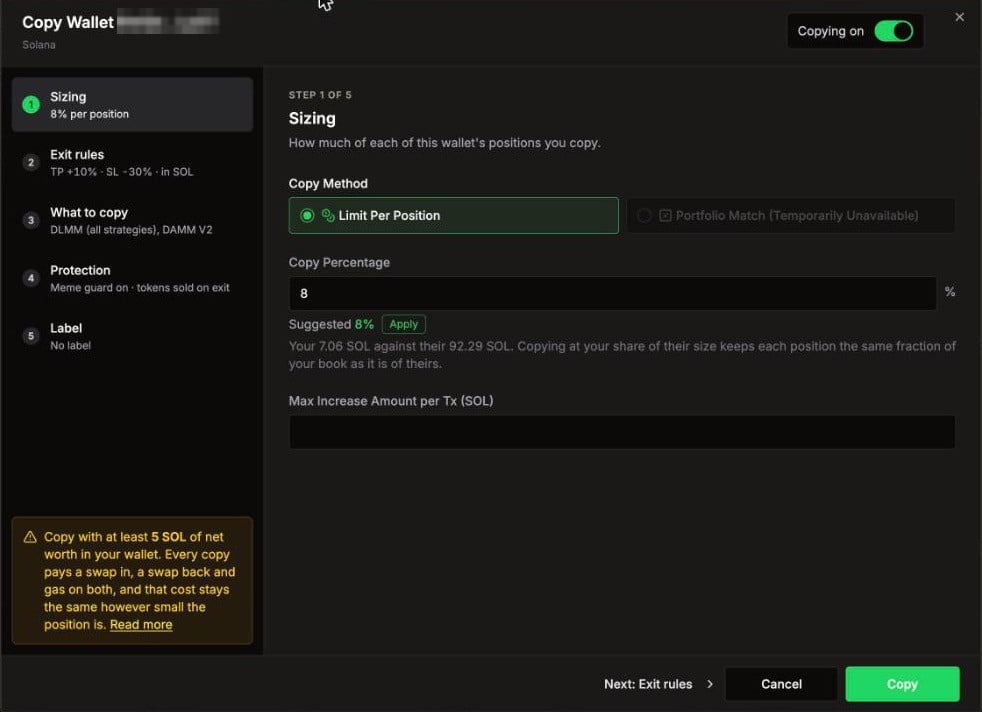
- You are much smaller than the leader: the field’s minimum is 1%, so the suggestion is raised to 1% and says so. Read that as the honest signal that this leader is too large for your wallet to copy meaningfully, since even their ordinary positions arrive scaled to more than your share
- You are much larger than the leader: the suggestion is capped at 10000%, and most of your capital sits idle
3. Fund Gas Separately From Position Capital
The most common reason a Robinhood copy fails to fire is that the agent wallet has run out of native ETH to pay gas. The follow looks healthy, the leader keeps opening positions, and nothing is copied. This catches users who deploy their whole balance. If your Max Increase Amount is the entire agent balance, the first copy consumes it and the next has nothing left to pay for gas.1
Fund the agent with more ETH than you intend to deploy
Treat a slice of the balance as gas that never gets allocated to a position.
2
Top it up when you top up capital
Every copy cycle spends gas four times, and closes cost gas too, including stop-loss exits you did not plan for.
3
Check the ETH balance first when copies stop appearing
An empty gas balance looks exactly like a quiet leader from the outside.
4. Avoid Leaders Who Flip Fast
A wallet that opens and closes positions every few minutes generates a full copy cycle each time, and you pay the round trip whether or not the leader made money on that flip. On Robinhood this is the most expensive mistake available, because each of those cycles is four transactions. Skip leaders whose average position age is under 1 hour. The settings screen shows a warning with the leader’s actual average hold time when it falls below that.The Solana guide draws this line at 18 minutes. Robinhood’s is stricter for the same reason everything else on this page is: an EVM cycle costs more per flip, so the same churn hurts more.
5. Set Risk Limits, and Expect Exits to Cost Something
Take Profit and Stop Loss work the same way as on Solana: whichever comes first, your threshold or the leader’s own exit, closes your position. Set a stop loss. Do not set it so tight that ordinary price movement triggers it, because every stop exit pays the same swap-back and gas that a planned exit pays. A stop that fires repeatedly on a small position can cost more than the loss it avoided.6. Read Robinhood PnL Carefully
Robinhood position PnL measures the liquidity leg only. The swaps that enter and exit a position are not booked into it, and on small positions their cost is material relative to the LP gain. Open positions do not carry a continuously refreshed value either. Reconcile against on-chain data before drawing conclusions about a leader, or about your own results. For your own closed copies, Copy Logs does part of this for you: a result checked against the on-chain transactions is marked True PnL. The full list is in Robinhood Chain Integration.Common Mistakes to Avoid
- Copying with less than 0.08 ETH in your agent wallet, where the round trip eats whatever the positions can earn
- Keeping an old Max Increase Amount of
0, which disables copying without disabling the follow - Picking a copy percentage by feel instead of from the ratio of net worths
- Deploying the entire agent balance and leaving nothing for gas
- Copying a high-frequency wallet and paying four transactions for each of their flips
- Judging a leader on reported PnL alone, before reconciling the swap legs on chain